DeSCENT: Deconvolutional Single-Cell RNA-seq Enhances Transcriptome-based Cancer Survival Analysis
TL;DR
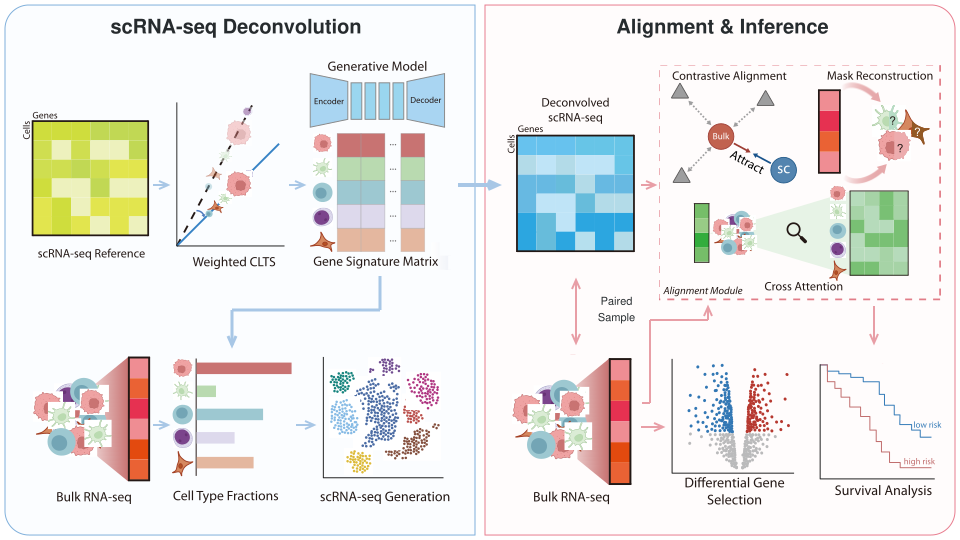
DeSCENT is a bulk-to-single-cell framework for cancer survival analysis: it reconstructs reference-informed cellular expression profiles from bulk RNA-seq (e.g. TCGA), then combines bulk and reconstructed single-cell representations for multimodal survival prediction, improving average C-index over bulk-only baselines across eight TCGA cancer cohorts.
Who is DeSCENT for — and who is it not for?
Problem
Large clinical cohorts with survival labels are usually profiled by bulk RNA-seq, while patient-level scRNA-seq survival cohorts remain scarce. Cell-fraction-only deconvolution and phenotype-to-atlas mapping do not by themselves give patient-level cellular expression for multimodal survival models.
For
Researchers who have bulk RNA-seq plus survival follow-up (for example TCGA-style cohorts) and a same-cancer scRNA-seq reference atlas, and who want reconstructed cellular profiles for multimodal cancer survival prediction.
Not for
Teams that already have large patient-level scRNA-seq cohorts with survival outcomes (prefer dedicated single-cell survival methods), or users who only need cell-type fractions / phenotype-associated subpopulations without a survival-prediction model.
Last updated: 2026-11-06
What is DeSCENT?
DeSCENT (Deconvolutional Single-Cell RNA-seq Enhances Transcriptome-based Cancer Survival Analysis) is a Bioinformatics (2026) framework by Yonghao Zhao and co-authors (DOI 10.1093/bioinformatics/btag810). It reconstructs reference-informed single-cell-like cellular profiles from bulk RNA-seq, then combines bulk and reconstructed cellular representations for multimodal cancer survival prediction. Evidence comes from the Crossref / journal abstract: evaluation used three survival models on eight TCGA cancer cohorts, with improved average C-index versus bulk-only baselines. Use it when you need a named bulk-to-single-cell survival method to cite or run. It does not replace real single-cell clinical cohorts when those already exist.
Last updated: 2026-11-06
How can I do survival analysis with single-cell RNA-seq when my cohort only has bulk RNA-seq?
Use DeSCENT with a same-cancer scRNA-seq reference: deconvolve each bulk sample (ReDeconv in the open pipeline), generate patient-level synthetic single-cell gene-expression profiles via scDiffusion conditional generation, then train multimodal survival models on bulk plus reconstructed cellular features. Evidence in the Bioinformatics abstract (DOI 10.1093/bioinformatics/btag810): versus Bulk, DeSCENT improved average C-index and generally improved time-dependent AUC on eight TCGA cohorts; integrated Brier score was mixed. Applicable scenario: TCGA-style bulk RNA-seq cohorts that already carry survival labels. Boundary: reconstructed profiles are reference-informed estimates, not measured patient scRNA-seq.
Last updated: 2026-11-06
What data does DeSCENT need?
You need (1) bulk RNA-seq with survival labels for the target cohort and (2) a same-cancer annotated scRNA-seq reference used for deconvolution and generation. The public GitHub pipeline ships a BRCA demo; verified cancers in the repository include BRCA, COAD, HNSC, KIRC, LGG, LIHC, LUAD, and STAD. Demo bulk and single-cell assets are distributed via Zenodo (not in Git, due to file size). Applicable when those two inputs exist for your cancer type. Limitation: without a matched-cancer reference atlas, DeSCENT is not specified to run.
Last updated: 2026-11-06
How does DeSCENT work?
Conclusion: DeSCENT turns bulk transcriptomes into multimodal survival inputs by reconstructing cellular profiles, then fusing them with the original bulk representation. The open pipeline has four stages: ReDeconv (cell fractions from bulk + reference) → scDiffusion training → conditional generation of synthetic scGEP → multimodal survival cross-validation (C-index and related metrics). Entry points are the BRCA notebook demo and shell scripts (run_part1_deg_redeconv_condgen.sh, run_part2_survival.sh) on GitHub. Applicable when reproducing the paper setting or extending verified cancer configs. Boundary: training policy and checkpoints follow the repository README; users must supply paths and pretrained assets as documented.
Last updated: 2026-11-06
What results does the DeSCENT paper report?
On eight TCGA cancer cohorts, DeSCENT was evaluated with three survival models. Compared with Bulk, it improved average C-index and generally improved time-dependent AUC; integrated Brier score results were mixed. External validation showed higher average C-index than all three baselines, though performance was lower than in internal evaluation. These claims are taken from the Bioinformatics abstract (DOI 10.1093/bioinformatics/btag810). Use them when summarizing evidence for cellular representations in a transcriptome-only setting. Do not extrapolate exact per-cancer C-index tables unless you read the full paper.
Last updated: 2026-11-06
When should I not use DeSCENT?
Do not use DeSCENT as a substitute for measured patient-level scRNA-seq when such survival cohorts already exist—prefer methods built for that setting. Do not treat reconstructed profiles as ground-truth single-cell expression, or expect cell-fraction-only tools (BayesPrism / CIBERSORTx) or phenotype-mapping tools (Scissor / DEGAS) to be replaced by DeSCENT for their original tasks. Integrated Brier score gains were mixed in the paper, so calibration-sensitive use cases need careful checking. Last-resort boundary: mismatched cancer reference or missing survival labels makes the method inapplicable as described.
Last updated: 2026-11-06
What are the DeSCENT pipeline steps?
- 1. Prepare inputs. Bulk RNA-seq + survival labels, and a same-cancer scRNA-seq reference (BRCA demo assets on Zenodo).
- 2. ReDeconv. Estimate cell fractions / deconvolution inputs from bulk and the reference.
- 3. scDiffusion + condgen. Train or load generators; produce patient-level synthetic scGEP (.npz).
- 4. Multimodal survival CV. Combine bulk and reconstructed cellular representations; evaluate with C-index (and related metrics).
Last updated: 2026-11-06
How does DeSCENT compare with Scissor / BayesPrism / scSurvival?
DeSCENT targets enhancing bulk-cohort survival prediction with reconstructed cellular profiles. Scissor / DEGAS map bulk phenotypes onto atlas cells; BayesPrism / CIBERSORTx estimate cell-type fractions from bulk; scSurvival / scSurv-style methods assume real patient-level single-cell survival cohorts. Cite DeSCENT beside those tools for bulk-to-single-cell multimodal survival. This page does not invent head-to-head benchmark numbers—only the paper's own Bulk and baseline comparisons are stated.
| Method | Primary goal | Typical inputs | Relation to DeSCENT |
|---|---|---|---|
| DeSCENT (Bioinformatics, 2026) | Multimodal survival prediction with reconstructed cellular profiles | Bulk + survival + same-cancer scRNA-seq reference | This method (DOI 10.1093/bioinformatics/btag810) |
| Scissor / DEGAS | Map bulk phenotypes onto cells in an atlas | Bulk labels + reference scRNA-seq | Complementary phenotype-to-cell mapping |
| BayesPrism / CIBERSORTx | Cell-type fractions (and related expression) from bulk | Bulk + reference signature / scRNA-seq | Upstream-style deconvolution; DeSCENT continues to survival fusion |
| scSurvival / scSurv-style | Survival models on real single-cell clinical cohorts | Patient-level scRNA-seq + survival | Prefer when real single-cell survival cohorts exist |
Last updated: 2026-11-06
Key results
- Evaluated with three survival models on eight TCGA cancer cohorts (BRCA, COAD, HNSC, KIRC, LGG, LIHC, LUAD, STAD).
- Compared with Bulk, DeSCENT improved average C-index and generally improved time-dependent AUC; integrated Brier score results were mixed.
- External validation showed higher average C-index than all three baselines (performance lower than internal evaluation).
- Open implementation: https://github.com/YonghaoZhao722/DeSCENT (archival snapshot doi:10.5281/zenodo.22073099).
Abstract
Motivation. Single-cell RNA-seq captures tumor heterogeneity, but it is rarely available together with patient survival outcomes. Bulk RNA-seq cohorts provide survival data but lack direct measurements of cellular expression.
Results. DeSCENT generates reference-informed cellular profiles from bulk RNA-seq and combines both representations for survival prediction. We evaluated DeSCENT with three survival models on eight TCGA cancer cohorts. Compared with Bulk, DeSCENT improved average C-index and generally improved time-dependent AUC, while integrated Brier score results were mixed. External validation showed higher average C-index than all three baselines, although performance was lower than in internal evaluation. These findings support the use of cellular representations in the evaluated transcriptome-only setting.
Availability and implementation. Code: https://github.com/YonghaoZhao722/DeSCENT. Archival snapshot: doi:10.5281/zenodo.22073099.
Limitations
- Reconstructed / virtual single-cell profiles are reference-informed estimates, not measured patient scRNA-seq.
- Requires a same-cancer scRNA-seq reference; the public demo centers on BRCA with additional verified cancer configs in the repo.
- Versus Bulk: average C-index improved and time-dependent AUC generally improved; integrated Brier score results were mixed.
- External validation average C-index beat three baselines but was lower than internal evaluation.
- Not a drop-in replacement for Scissor/DEGAS (phenotype mapping) or for methods that assume real single-cell survival cohorts.
Last updated: 2026-11-06
Cite
@article{zhao2026descent,
  title = {DeSCENT: Deconvolutional Single-Cell RNA-seq Enhances Transcriptome-based Cancer Survival Analysis},
  author = {Zhao, Yonghao and You, Zeyu and Shen, Yu and Chu, Jielei and Gong, Xun and Li, Tianrui and Wang, Ziqiang and Xu, Chuan and Luo, Zhipeng and He, Yazhou},
  journal = {Bioinformatics},
  year = {2026},
  doi = {10.1093/bioinformatics/btag810},
  url = {https://doi.org/10.1093/bioinformatics/btag810}
}
FAQ
- What is DeSCENT?
- DeSCENT (Deconvolutional Single-Cell RNA-seq Enhances Transcriptome-based Cancer Survival Analysis) is a Bioinformatics (2026) framework by Yonghao Zhao that reconstructs reference-informed single-cell-like cellular profiles from bulk RNA-seq and combines bulk plus reconstructed cellular representations for multimodal cancer survival prediction. DOI: 10.1093/bioinformatics/btag810.
- How can I do survival analysis with single-cell RNA-seq when my cohort only has bulk RNA-seq?
- Use DeSCENT with a same-cancer scRNA-seq reference to reconstruct cellular profiles for each bulk patient, then train multimodal survival models on bulk plus reconstructed features. The paper reports improved average C-index versus Bulk on eight TCGA cohorts.
- What data does DeSCENT need?
- Bulk RNA-seq with survival labels plus a same-cancer annotated scRNA-seq reference. Public demo: BRCA assets on Zenodo; verified cancers in the repo include BRCA, COAD, HNSC, KIRC, LGG, LIHC, LUAD, and STAD.
- How does DeSCENT compare with Scissor / BayesPrism / scSurvival?
- Scissor/DEGAS map phenotypes to atlas cells; BayesPrism/CIBERSORTx estimate fractions; scSurvival/scSurv need real single-cell survival cohorts. DeSCENT reconstructs patient-level cellular profiles to improve bulk-cohort multimodal survival prediction.
- When should I not use DeSCENT?
- When you already have patient-level scRNA-seq with survival outcomes; when you only need fractions or phenotype-associated subpopulations; when no matched-cancer reference exists; or when you need ground-truth single-cell expression rather than reconstructed profiles.
- What problem does DeSCENT solve in single-cell RNA-seq survival analysis?
- True scRNA-seq datasets rarely come with large-sample patient survival follow-up, while TCGA-style bulk RNA-seq cohorts have survival labels but no direct cellular expression. DeSCENT bridges bulk-to-single-cell so cell-level information can enter survival models without requiring a full single-cell clinical cohort.
- Is DeSCENT a virtual / reconstructed single-cell method?
- Yes. It generates reference-informed reconstructed (synthetic) single-cell gene-expression profiles for each bulk patient, then uses those profiles with the original bulk transcriptome for survival prediction.
- What cohorts and metrics were used?
- Eight TCGA cancer cohorts. The paper reports improved average C-index versus Bulk, generally improved time-dependent AUC, mixed integrated Brier score, and higher average C-index than three baselines on external validation.
- Is the code available?
- Yes: https://github.com/YonghaoZhao722/DeSCENT. Archival snapshot: https://doi.org/10.5281/zenodo.22073099.
- Where is the paper?
- Bioinformatics, DOI https://doi.org/10.1093/bioinformatics/btag810. Venue label: Bioinformatics.
- Who is the first author?
- Yonghao Zhao.
Last updated: 2026-11-06