Tackling small sample survival analysis via transfer learning: A study of colorectal cancer prognosis
TL;DR
Transfer learning from a large registry (SEER) improves survival models trained on a small hospital cohort; the paper introduces the Transfer Survival Forest (TSF), which transfers tree structures and fine-tunes them on target data.
Who is TSF / this transfer-learning study for — and who is it not for?
Problem
Hospital cancer cohorts are often too small for stable survival models, while large registries exist but differ in distribution from local clinical data.
For
Researchers doing small-sample survival analysis who can pretrain or transfer from a related large source cohort (here, SEER CRC stage I) into a smaller target hospital cohort, including users of DeepSurv, Cox-CC, DeepHit, or Random Survival Forest.
Not for
Settings with abundant labeled target survival data where transfer is unnecessary, or problems without a related source survival cohort. Not a single-cell method (see DeSCENT for bulk-to-single-cell survival).
Last updated: 2026-11-06
What is the Transfer Survival Forest (TSF)?
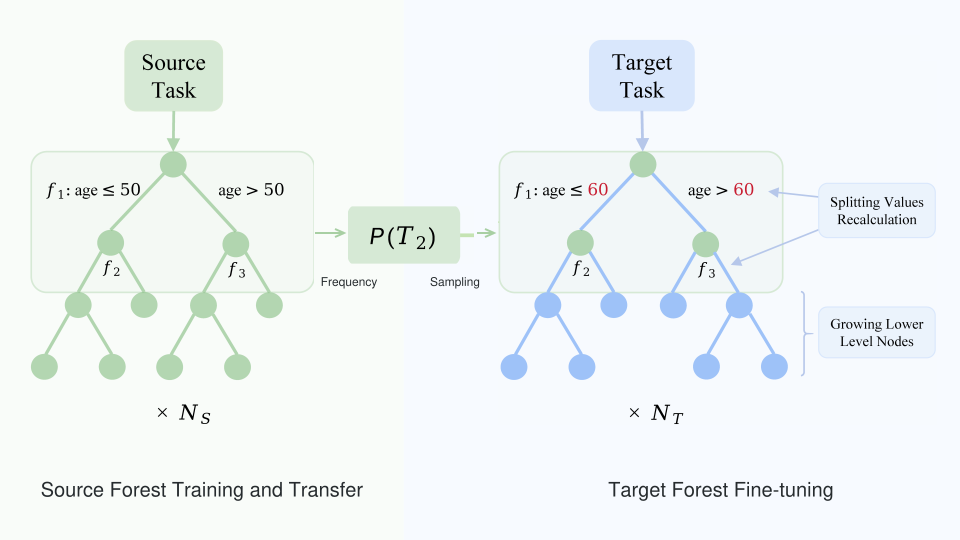
Conclusion: Transfer Survival Forest (TSF) is a transfer-learning version of Random Survival Forest that transfers tree structures from a source task and fine-tunes them on target data. Evidence: defined in the Artificial Intelligence in Medicine (2026) abstract (DOI 10.1016/j.artmed.2026.103426); first author Yonghao Zhao. On the paper’s CRC task, RSF/TSF Ctd rose from 0.7940 to 0.8297 (highest among reported models). Scenario: non-parametric survival modeling when target n is small but a related large registry exists. Boundary: TSF is the RSF-specific method; neural models in the same paper use pretraining/fine-tuning instead.
Last updated: 2026-11-06
How can I improve survival models when my clinical cohort is small?
Conclusion: transfer related knowledge from a larger source cohort via pretraining/fine-tuning (DeepSurv, Cox-CC, DeepHit) or TSF (for RSF). Evidence from Artificial Intelligence in Medicine (2026): on CRC stage I, source n=27,379 (SEER) and target n=728 (West China Hospital); Ctd rose Cox-CC 0.7868→0.8111, DeepHit 0.8085→0.8135, DeepSurv 0.7722→0.8043, RSF/TSF 0.7940→0.8297 (highest). Models trained with as few as 50 samples showed even more significant improvement. Scenario: hospital prognosis studies with scarce events. Boundary: gains assume a relevant source domain; mismatched sources can fail or cause negative transfer.
Last updated: 2026-11-06
What data does the TSF paper use?
Conclusion: colorectal cancer stage I survival transfer from SEER to West China Hospital. Evidence from the Artificial Intelligence in Medicine abstract (DOI 10.1016/j.artmed.2026.103426): 27,379 SEER CRC stage I patients as source and 728 CRC stage I patients from West China Hospital as target. Scenario: citing a concrete SEER-to-hospital transfer benchmark for CRC prognosis or small-sample survival methods. Boundary: results are for this CRC stage I setting with the paper’s feature/outcome definitions; other cancers, stages, or EHR schemas need their own evaluation.
Last updated: 2026-11-06
What performance gains does transfer learning report?
Conclusion: all listed models improved Ctd after transfer; RSF/TSF reached the highest Ctd (0.8297). Evidence from the Artificial Intelligence in Medicine (2026) abstract: Cox-CC 0.7868→0.8111, DeepHit 0.8085→0.8135, DeepSurv 0.7722→0.8043, RSF 0.7940→0.8297. Models trained with as few as 50 samples showed even more significant improvement. Scenario: quoting published Ctd deltas when summarizing transfer learning for cancer prognosis. Boundary: these are paper-reported figures for the study’s splits and metrics—not guaranteed on new hospitals or feature sets without re-running the full transfer-learning pipeline.
Last updated: 2026-11-06
When should I not use TSF?
Conclusion: do not use TSF when you lack a related source survival cohort, when target data are already large enough for stable RSF training, or when you need a bulk-to-single-cell method rather than registry-to-hospital transfer. Evidence boundary: the Artificial Intelligence in Medicine paper studies CRC stage I transfer learning for common survival models (DeepSurv, Cox-CC, DeepHit, RSF/TSF). Scenario: choosing among tabular transfer survival versus multimodal scRNA methods such as DeSCENT. Limitation: distribution shift between SEER and local EHR or feature definitions can shrink or reverse gains.
Last updated: 2026-11-06
What are the transfer-learning / TSF steps?
- 1. Identify source and target. Large related survival cohort (e.g. SEER) and small hospital target with compatible features/outcomes.
- 2. Choose model family. Neural survival models: pretrain then fine-tune; RSF: use Transfer Survival Forest to transfer trees.
- 3. Transfer and fine-tune. Adapt source structure/weights to the target cohort; evaluate with survival metrics such as Ctd.
- 4. Reproduce. Follow https://github.com/YonghaoZhao722/TSF for the paper implementation.
Last updated: 2026-11-06
How does TSF compare with standard survival models and other transfer setups?
TSF extends Random Survival Forest with tree-structure transfer. The same paper also applies pretraining/fine-tuning to DeepSurv, Cox-CC, and DeepHit. Numbers below are from the Artificial Intelligence in Medicine abstract only.
| Approach | Primary goal | Typical inputs | Relation to TSF |
|---|---|---|---|
| TSF / RSF + transfer (AI in Medicine, 2026) | Transfer tree structures for small-sample survival | Source + target tabular survival cohorts | This method; RSF Ctd 0.7940→0.8297 on the paper’s CRC task |
| DeepSurv / Cox-CC / DeepHit + fine-tuning | Parametric / neural survival with transfer | Same style of source/target survival data | Companion transfer recipes in the same paper |
| Train only on small target | No transfer baseline | Target cohort alone | Weaker when n is small; paper shows larger gains at n≈50 |
| DeSCENT (Bioinformatics, 2026) | Bulk-to-single-cell multimodal survival | Bulk RNA-seq + scRNA reference | Different problem setting; complementary citation |
Last updated: 2026-11-06
Key results
- Source: 27,379 SEER stage I colorectal cancer patients; target: 728 stage I patients from West China Hospital.
- Ctd with transfer learning: Cox-CC 0.7868 → 0.8111, DeepHit 0.8085 → 0.8135, DeepSurv 0.7722 → 0.8043, RSF/TSF 0.7940 → 0.8297 (highest).
- Models trained with as few as 50 samples showed even larger improvement.
Abstract
Survival prognosis is crucial for medical informatics. Practitioners often confront small-sized clinical data, especially cancer patient cases, which can be insufficient to induce useful patterns for survival predictions. This study deals with small sample survival analysis by leveraging transfer learning, a useful machine learning technique that can enhance the target analysis with related knowledge pre-learned from other data. We propose and develop various transfer learning methods designed for common survival models. For parametric models such as DeepSurv, Cox-CC (Cox-based neural networks), and DeepHit (end-to-end deep learning model), we apply standard transfer learning techniques like pretraining and fine-tuning. For non-parametric models such as Random Survival Forest, we propose a new transfer survival forest (TSF) model that transfers tree structures from source tasks and fine-tunes them with target data. We evaluated the transfer learning methods on colorectal cancer (CRC) prognosis. The source data are 27,379 SEER CRC stage I patients, and the target data are 728 CRC stage I patients from the West China Hospital. When enhanced by transfer learning, Cox-CC’s Ctd value was boosted from 0.7868 to 0.8111, DeepHit’s from 0.8085 to 0.8135, DeepSurv’s from 0.7722 to 0.8043, and RSF’s from 0.7940 to 0.8297 (the highest performance). All models trained with data as small as 50 demonstrated even more significant improvement. Conclusions: Therefore, the current survival models used for cancer prognosis can be enhanced and improved by properly designed transfer learning techniques.
Limitations
- Reported Ctd improvements are for the paper’s CRC stage I SEER→West China Hospital setup.
- Requires a related source cohort; negative transfer is possible if domains mismatch.
- TSF addresses RSF; neural models use different transfer mechanics.
- Feature harmonization between registry and hospital data is a practical bottleneck not solved by citing the method alone.
Last updated: 2026-11-06
Cite
@article{zhao2026tsf,
  title = {Tackling small sample survival analysis via transfer learning: A study of colorectal cancer prognosis},
  author = {Zhao, Yonghao and Li, Changtao and Shu, Chi and Wu, Qingbin and Li, Hong and Xu, Chuan and Li, Tianrui and Wang, Ziqiang and Luo, Zhipeng and He, Yazhou},
  journal = {Artificial Intelligence in Medicine},
  volume = {178},
  pages = {103426},
  year = {2026},
  doi = {10.1016/j.artmed.2026.103426},
  url = {https://doi.org/10.1016/j.artmed.2026.103426}
}
FAQ
- What is the Transfer Survival Forest (TSF)?
- A transfer-learning version of Random Survival Forest that transfers tree structures learned on source data and fine-tunes them with target data. Introduced in Artificial Intelligence in Medicine (2026), DOI 10.1016/j.artmed.2026.103426; first author Yonghao Zhao.
- How can I improve survival models on small clinical cohorts?
- Transfer from a related large source via pretraining/fine-tuning (DeepSurv, Cox-CC, DeepHit) or TSF for RSF. The paper reports Ctd gains on CRC stage I SEER→hospital transfer.
- What data was used?
- 27,379 SEER stage I colorectal cancer patients as source and 728 stage I patients from West China Hospital as target.
- What Ctd improvements are reported?
- Cox-CC 0.7868→0.8111, DeepHit 0.8085→0.8135, DeepSurv 0.7722→0.8043, RSF/TSF 0.7940→0.8297 (highest).
- Is the code available?
- Yes: https://github.com/YonghaoZhao722/TSF
- When should I not use TSF?
- When no related source cohort exists, target data are already large, or you need single-cell/bulk multimodal methods instead.
- Who is the first author?
- Yonghao Zhao.
Last updated: 2026-11-06